
What are deep groove ball bearings used for
Deep groove ball bearings serve electric motors, gearboxes, pumps, automotive components, household appliances, and general machinery. These bearings carry radial loads and limited axial loads in both directions. They do this job efficiently and at low cost. The range runs from small consumer equipment to heavy industrial machinery. Specific applications, comparisons with other bearing types, and selection guidance appear below. Readers gain a practical answer for matching a bearing to real equipment needs.
Key Takeaways
Deep groove ball bearings carry radial loads and limited axial loads in both directions.
These bearings run with low friction and low noise at many speeds.
Electric motors, pumps, and household appliances commonly use deep groove ball bearings.
Choose deep groove ball bearings for radial loads with moderate axial loads.
Select the right seal type for your environment: open, ZZ, or 2RS.
Why Deep Groove Ball Bearings Are So Versatile
A Simple, Robust Structure
A deep groove ball bearing has an inner ring and an outer ring, each with a deep raceway groove. A cage holds the balls in place between the rings. The design is non-separable, so the assembled unit stays together during handling and installation. The deep grooves let the balls contact the raceways along a broad arc. This geometry allows the bearing to carry radial loads and limited axial loads in both directions. That dual capability explains much of the bearing's wide appeal.
The structure also keeps manufacturing straightforward. Standard bearing steel, common ball sizes, and well-established grinding processes support stable quality at reasonable cost. Stainless steel options exist for selected models. A simple structure with few parts means fewer failure points and predictable behavior in service.
Key Advantages for Rotational Support
Low friction stands out among the benefits. Rolling contact instead of sliding contact keeps friction and heat low. Quiet running follows from smooth raceways and precise ball geometry. These bearings suit low speeds and very high speeds alike, so one bearing family covers many duty cycles. Precision reduces energy consumption and extends equipment life.
These traits map directly onto common equipment. Electric motors need quiet, low-loss rotation at high speed. Pumps need steady radial support with modest axial control. General machinery needs a dependable default that installs easily and lasts. Deep groove ball bearings meet all three needs without special housing designs or complex mounting procedures. That combination of simple structure, broad load capability, and efficient running makes them a practical first choice for rotational support across many machines.
Common Uses for Deep Groove Ball Bearings
Motors, Automotive, and Industrial Equipment
Electric motors rank among the largest users of these bearings. A motor needs smooth, low-friction rotation at high speed, and the deep groove design delivers exactly that. Gearboxes use them on input and output shafts. Pumps rely on them for steady radial support under continuous duty. Compressors and fans follow the same pattern, where quiet running and energy efficiency matter day after day.
Automotive applications spread across the vehicle. Transmission and differential shafts often pair deep groove ball bearings with tapered roller bearings, so each type handles the load direction it manages best. Robotics adds another growing field. Joints and drive units in robotic arms need compact bearings that run quietly and hold position with precision.
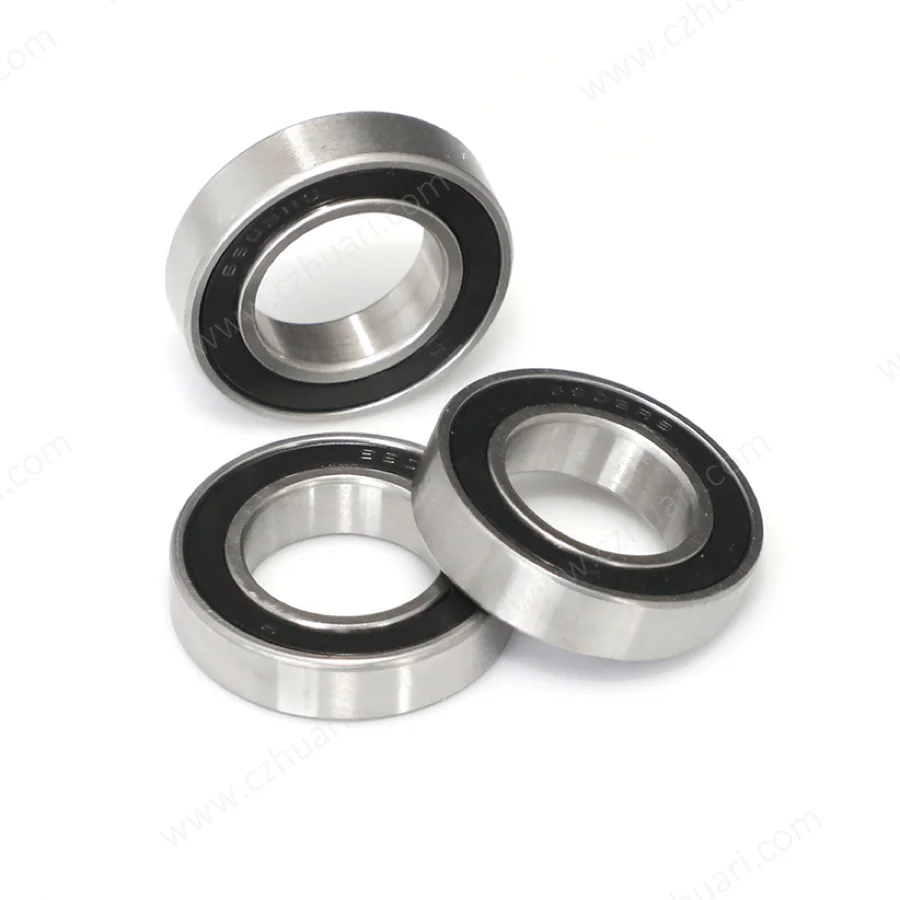
Changzhou Huari Steel Ball Co., Ltd. supplies common series including 6000, 6200, 6300, 6800, and 6900. Each series covers a range of bore sizes, so designers can match shaft dimensions without changing bearing family. Open, metal-shielded (ZZ), and rubber-sealed (2RS) designs suit different operating environments. Standard bearings use bearing steel, and stainless steel options serve selected models. Lubrication can be grease or oil as needed, and internal clearance and sealing structures are selectable per model and application.
Appliances, Power Tools, and Medical Devices
Household appliances form a huge market for deep groove ball bearings. Washing machines, refrigerators, air conditioners, and vacuum cleaners all depend on quiet, long-life rotation. Bicycles use them in hubs, bottom brackets, and headsets, where low friction and simple installation matter. Power tools such as drills and grinders need compact bearings that tolerate high speed and vibration. Medical equipment demands precision and reliability, and sealed designs keep lubricant in place through repeated cleaning cycles.
The sealed variants play a key role here. The ZZ metal shield blocks dust and coarse particles. The 2RS rubber seal retains grease and excludes moisture. Both options extend service life in dirty or damp conditions without adding maintenance steps.
Huari also offers matching supply. Bearings can ship together with steel balls and related components, which simplifies procurement for assembly operations. A buyer places one order and receives a coordinated set of parts.
How They Compare With Other Bearing Types
Angular Contact, Self-Aligning, and Roller Bearings
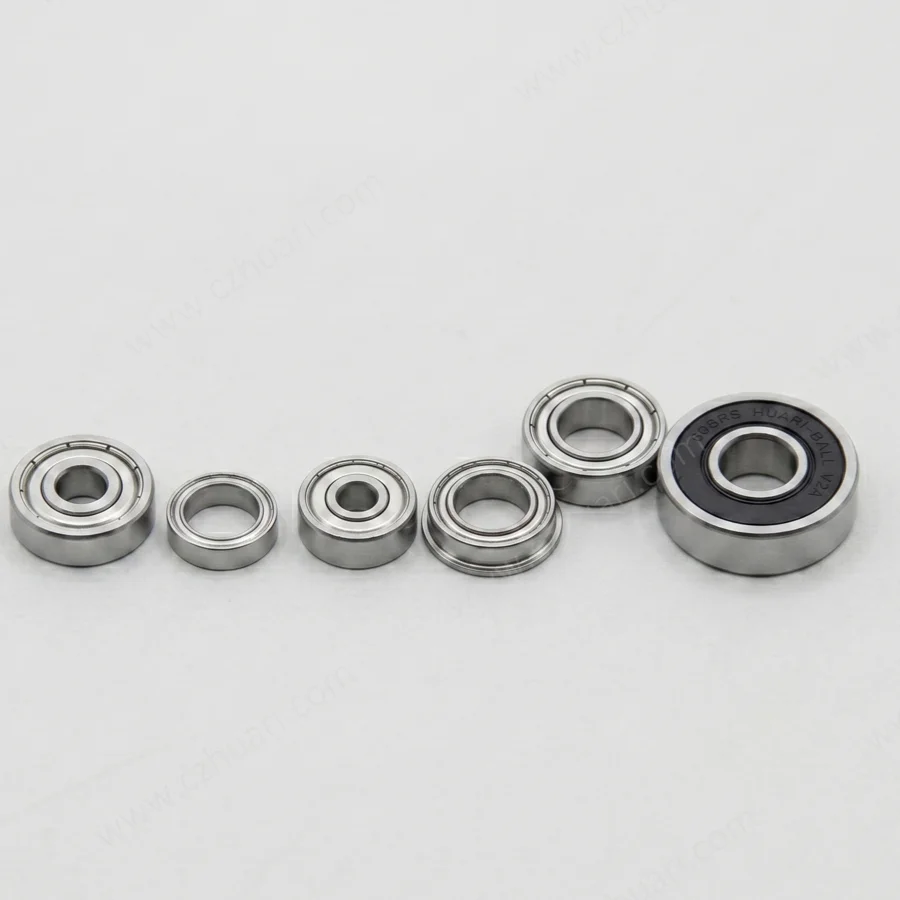
Each bearing family solves a different load problem. Angular contact bearings place the balls at an angle to the raceway. That angle lets them carry heavy axial loads in one direction, often in pairs. Self-aligning bearings tolerate shaft misalignment and deflection, which suits long shafts and flexible frames. Roller bearings spread load over a line of contact instead of a point. Cylindrical, spherical, and tapered rollers therefore handle much heavier radial loads than ball bearings of similar size.
Deep groove ball bearings sit at the center of this group. They carry radial loads and moderate axial loads in both directions, and they run at high speed with low friction. Their simple structure keeps cost low and availability wide. The table below shows where each type fits best.
Bearing type | Best fit |
|---|---|
Deep groove ball | Radial load with moderate axial load, both directions, high speed |
Angular contact | Heavy axial load in one direction, paired arrangements |
Self-aligning | Shaft misalignment and deflection |
Roller | Heavy radial load, shock load, large shaft diameters |
Matching Bearing Type to Application Needs
Load direction drives the first decision. A radial load with modest axial control points to a deep groove bearing. A dominant axial load in one direction points to an angular contact bearing. Heavy radial or shock loads point to a roller bearing. Misalignment risk points to a self-aligning design.
Cost and speed follow the load choice. Deep groove ball bearings usually cost less than precision angular contact or roller bearings of comparable size. They also reach higher speeds with less friction. Engineers often start with this type and move to a specialized bearing only when the load case demands it. That approach keeps designs simple and budgets predictable.
Looking For Reliable Precision Steel Ball Manufacturer?
Huari is a professional factory specializing in full-range precision steel balls. We supply chrome steel balls, stainless steel balls, carbon steel balls and custom special metal balls, with stable roundness and hardness, widely used in bearings, automotive, valves, instruments and industrial transmission fields, OEM & ODM service available.
How to Select Deep Groove Ball Bearings
Size, Load, and Speed
Selection starts with the shaft. The bore size sets the bearing series, and the housing space sets the outer diameter and width. A designer checks the radial load first, then the axial load. Deep groove ball bearings carry radial loads well and accept limited axial loads in both directions. A load case with heavy thrust in one direction calls for a different bearing type.
Speed shapes the choice as well. These bearings run smoothly at low speeds and at very high speeds, so most duty cycles fall inside their range. The designer confirms the speed rating for the exact model, because cage design and lubrication affect the limit. A quick check of load, speed, and available space usually narrows the field to one or two candidates.
Environment, Sealing, and Lubrication
The operating environment decides the seal. An open bearing suits clean, oil-lubricated housings. The ZZ metal shield blocks dust and coarse particles. The 2RS rubber seal keeps grease in and moisture out. Grease or oil lubrication is available as needed, and internal clearance and precision are confirmed per model and application.
Huari supports customization for special cases. Options include special clearances, non-standard dimensions, and OEM labeling. Supply can be arranged by bearing model, drawing, sample, or confirmed specification. Inspection covers dimensions, rotation, appearance, and agreed requirements.
For a quotation, buyers should provide:
Bearing model and dimensions
Seal type and material
Quantity and application details
Deep groove ball bearings serve a broad range of applications. Electric motors, gearboxes, pumps, appliances, and general machinery all rely on them. Their balance of versatility, efficiency, and cost explains this wide use.
The link between features and applications stays clear. Deep raceway grooves carry radial loads and limited axial loads. Low friction supports quiet, high-speed running. Selection still depends on load, speed, sealing, and environment.
Readers can use the comparison and selection guidance above to match the right bearing to a specific use case. Check the load direction first, then confirm speed, seal type, and operating conditions.
FAQ
What loads can a deep groove ball bearing carry?
The deep raceway grooves let the bearing carry radial loads and limited axial loads in both directions. A load case with heavy thrust in one direction calls for a different bearing type, such as an angular contact bearing.
Which seal type should a buyer choose?
The choice depends on the operating environment. An open bearing suits clean, oil-lubricated housings. The ZZ metal shield blocks dust and coarse particles. The 2RS rubber seal keeps grease in and moisture out.
Which series covers common shaft sizes?
Huari supplies the 6000, 6200, 6300, 6800, and 6900 series. Each series covers a range of bore sizes, so a designer can match shaft dimensions without changing the bearing family. Internal clearance and precision are confirmed per model and application.
Can Huari customize bearings for special requirements?
Yes. Options include special clearances, non-standard dimensions, and OEM labeling. Huari accepts supply arrangements by bearing model, drawing, sample, or confirmed specification. Inspection covers dimensions, rotation, appearance, and agreed requirements.
What details does a quotation request need?
A buyer should provide the bearing model, dimensions, seal type, material, quantity, and application details. Huari confirms delivery time according to model, quantity, and supply conditions. Packing options include individual boxes, industrial packing, or customized packaging.