
What are ceramic balls used for
Ceramic balls serve four main roles in industry: catalyst bed supports, grinding and milling media, thermal storage media, and precision components in bearings and valves. Manufacturers produce them in several materials, including alumina, silicon carbide, silicon nitride, and zirconia. Each material brings a distinct balance of hardness, chemical inertness, wear resistance, and thermal stability. Alumina offers balanced hardness and insulation, silicon carbide handles extreme heat and abrasion, silicon nitride delivers thermal shock resistance, and zirconia provides the highest toughness among the mainstream oxides, according to ACS Material. The right grade depends on the process conditions. This practical application map helps readers match ceramic balls to their specific process or industry.
Key Takeaways
Ceramic balls support catalyst beds in reactors. They hold the catalyst, spread gas and liquid flow, and protect the catalyst from damage.
Ceramic balls grind materials into fine powders. They are hard, wear-resistant, and do not contaminate the product with metal particles.
Ceramic balls store heat in packed beds. They absorb heat from hot gas and release it to cold gas, helping save energy.
Ceramic balls make bearings and valves last longer. They are lightweight, tough, and resist corrosion, which suits harsh conditions.
Ceramic balls also filter water and treat it. They remove impurities and can even raise pH by releasing minerals.
Catalyst Bed Support
Reactor and Tower Packing
Fixed-bed reactors, adsorption towers, catalytic reforming, hydrocracking, and hydrotreating units all rely on a support layer beneath the active catalyst. Ceramic balls fill this role as inert bed support packing. They sit under molecular sieves, activated alumina, and catalyst granules. The layer performs several jobs at once:
It carries the weight of the catalyst bed and spreads that load onto the reactor's bottom grid.
It distributes gas and liquid evenly across the vessel cross-section.
It prevents channeling and localized pressure drop.
It shields the active material from crushing and erosion.
It blocks fine catalyst dust from reaching downstream pipes and heat exchangers.
Installers load the balls in graded layers. Large balls go at the bottom, and progressively smaller balls sit above them, up to the catalyst. This graded filling method stops fine particles from leaking into the grid and blocking the outlet.
Inertness and Purity
The support layer must stay chemically silent. It should not adsorb, react, or catalyze. Dense firing gives these balls low water absorption, so they do not soak up process liquid. Common alumina-porcelain grades (Al₂O₃ 17–23%) handle standard support duty, while mid-alumina grades (23–40%) suit hotter, heavier service. A typical specification from RJ Chem Packing illustrates the range:
Property | Value |
|---|---|
Al₂O₃ content | 17–23% |
Water absorption | ≤2% |
Mohs hardness | >6.5 |
Max operating temp | ~1000°C |
Crush strength | ≥0.3 kN (φ3) to ≥15 kN (φ50) |
Purity matters most near precious metal catalysts. Silica or iron impurities from a standard ball can migrate to the catalyst surface and reduce its activity over the bed's life. High-purity 99.7% alumina removes that risk, according to Sorbitech. Only intact balls with smooth surfaces should be loaded, and they should stay dry before installation. At changeout, operators recover, wash, and inspect the ceramic balls for breakage before reinstalling them with the new active bed.
Ceramic Balls as Grinding Media
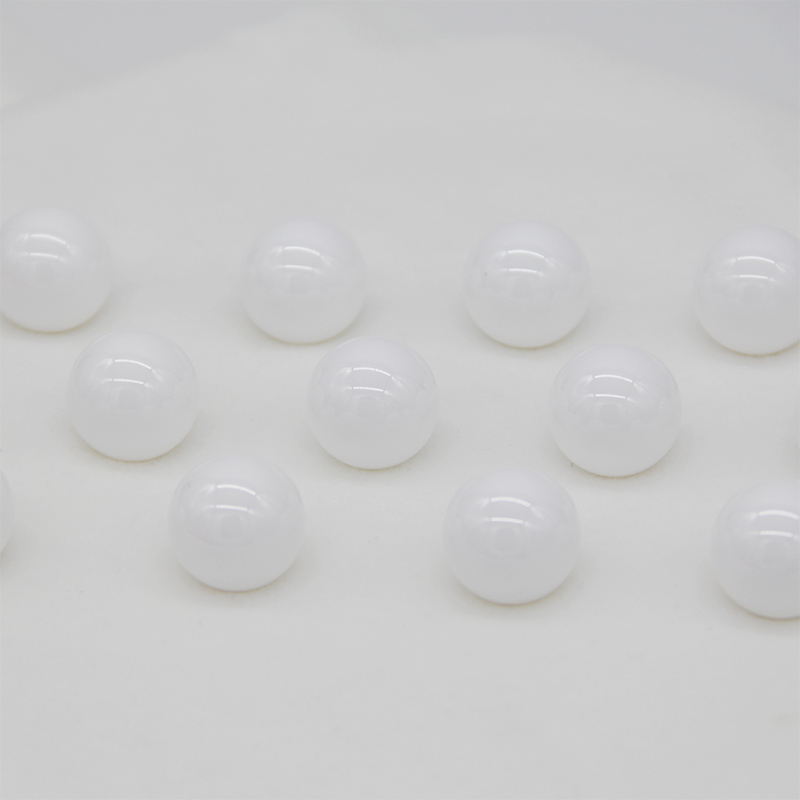
Ball Mills and Attrition Mills
Grinding media break raw material into finer particles inside ball mills, attrition mills, and stirred mills. Ceramic balls offer a different balance of properties than steel media. Their lower density means the mill needs less energy to tumble the charge, which cuts power consumption. Their high hardness keeps the surface sharp and resistant to abrasion. STR Industries lists typical ceramic media at Mohs 8.5 to 9, compared with 60 to 67 HRC for chrome steel. The table below shows how the two families differ.
Attribute | Steel balls | Ceramic balls |
|---|---|---|
Density | ~7.8 g/cm³ | 3.6 to 6.1 g/cm³ (alumina to zirconia) |
Hardness | 60 to 67 HRC (chrome steel) | Mohs 8.5 to 9 |
Impact toughness | Excellent | Good (zirconia best in class) |
Contamination | Iron/chromium wear debris | Minimal; no metallic ions |
Corrosion resistance | Low (stainless grades better) | Excellent |
Best for | Mining, cement, coarse grinding | Pharma, food, pigments, ultra-fine milling |
Media selection also depends on ball size and grading. Large balls handle coarse feed, medium balls perform secondary grinding, and small balls complete fine grinding. A graded charge often outperforms a single size. Operators should also match media chemistry to the powder, because wear debris can shift composition, color, or sintering behavior, according to CeramPrime.
Wear Resistance and Low Contamination
Ceramic media resist wear far better than steel in fine grinding stages. Lower wear rates reduce media consumption and mill downtime. The non-metallic composition also removes a contamination pathway. Steel media shed iron and chromium debris with every impact, and that debris enters the product. Ceramic media release minimal debris and no metallic ions, which matters when a specification limits iron, chromium, or other metal content. Pharmaceuticals, food, white pigments, and battery materials all fall into this group, according to STR Industries.
Material choice follows the duty. Alumina suits general ceramic milling, paints, and minerals at a lower cost. Zirconia, especially yttria-stabilized grades, brings high density and exceptional fracture toughness, and it sets the standard for contamination-free fine and ultra-fine milling in pharmaceuticals, food, inks, and electronic materials. Silicon nitride offers very high hardness and thermal stability for advanced ceramics and aerospace work. Zirconia-toughened alumina combines alumina purity with zirconia strength, and its small particle sizes suit ultra-fine grinding.
Wear life depends on more than alumina content alone. Density, hardness, microstructure, sintering quality, ball size and shape, and mill operating conditions all shape service life. Users should measure media loss and powder contamination over time rather than assume a grade will perform. Matching ceramic balls to the mill type, feed size, and purity target gives the most reliable result.
Thermal Storage and Heat Transfer
Packed-Bed Systems
Loosely packed ceramic balls form a dense bed with many gaps between the spheres. Hot flue gas passes through the bed, and the balls absorb and store that heat. Cold gas then flows through in the opposite direction, and the balls release the stored heat to warm the incoming stream. Switching the gas flow direction periodically lets the packing run continuous absorption, storage, and release cycles for waste-heat recovery, according to EPCreater. Alumina-based media also serve regenerative thermal storage in air separation units and solar thermal projects, where the thermal mass holds energy for dispatch when solar input is unavailable, Blasch Ceramics notes. In steel blast furnaces, regenerative accumulators preheat both combustion air and fuel gas so the furnace reaches its target flame temperature quickly.
Ball diameter drives the trade-off between heat transfer and pressure drop. Smaller balls give more specific surface area and faster heat exchange, but they raise gas-flow resistance. Larger balls lower resistance but reduce the transfer area. EPCreater recommends sizing the balls against the equipment's design gas velocity, allowable pressure drop, and heat-exchange target. The table below compares loose ball packing with honeycomb ceramic regenerators.
Attribute | Ceramic heat-storage balls | Honeycomb ceramic regenerators |
|---|---|---|
Structure | Loose spherical packing | Parallel channels |
Specific surface area | Lower | 5.5 times of 15 mm balls |
Gas-flow resistance | Higher | Low flow resistance |
Strength | High strength | Relatively poor due to thin-wall structure |
Replacement/cleaning | Easy to replace and reusable | Cleaning and replacement is complex |
Suitable conditions | Dust-laden flue gas, high-strength duty | Clean flue gas requiring low pressure drop |
High-Temperature Stability
Thermal cycling decides how long the bed lasts. Alumina media carry a specific heat capacity of about 0.88 J/g·K and stay stable above 1,600°C, well beyond the 800–1,000°C range of most regenerative oxidizer service, according to C-AdTech. A typical regenerative thermal oxidizer cycles its bed through heating and cooling hundreds of thousands of times. Thermal shock resistance and dimensional stability over that cycling set the system's operating life between media changes. In aggressive duty such as sulfuric acid service or reformer catalyst support, service life of 3–7 years is typical. Chemical attack and thermal shock fatigue are the main degradation paths.
Buyers should weigh five properties when they specify ceramic balls for heat duty, per EPCreater:
Heat capacity (specific heat): heat stored per unit mass
Thermal conductivity: speed of heat transfer
Thermal shock resistance: tolerance of sharp temperature swings
Volume density: heat-storage capacity per unit volume
Refractoriness
Ceramic Balls in Bearings and Valves
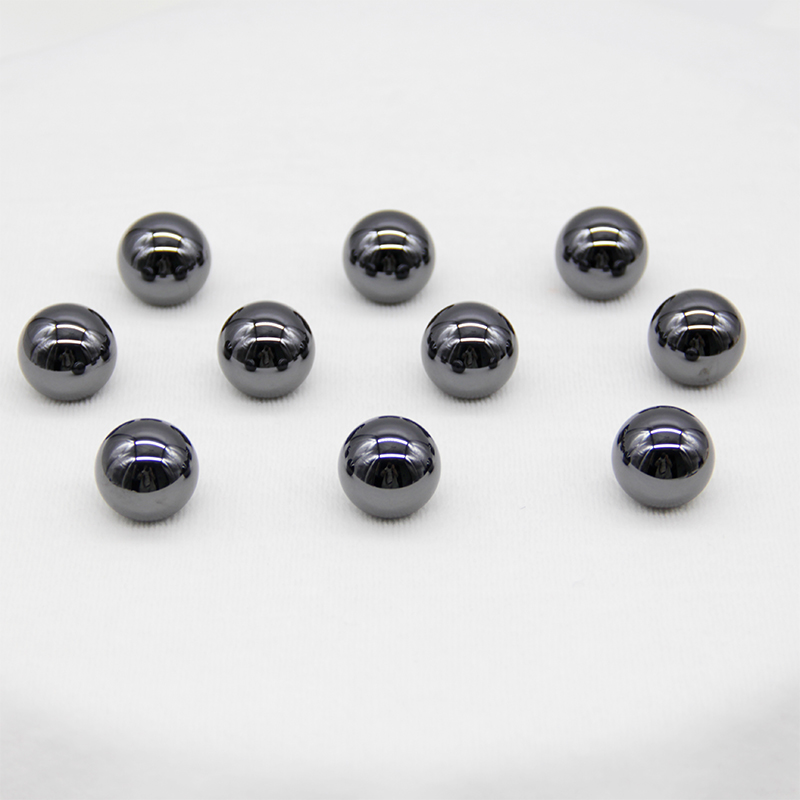
Bearings for Wind, Aerospace, and Motors
Rolling bearings in wind turbine main shafts and gearboxes must run for 20+ years without maintenance, according to HAXB Bearings. Ceramic rolling elements hold up under high load, high temperature, and complex lubrication conditions. Jet engines, flight control actuators, machine tool spindles, electric motors, and racing cars all draw on the same strengths: low mass, high stiffness, and stable operation at extreme temperature.
Silicon nitride suits high-speed, low-friction duty. Its density is only 60% of steel, and silicon nitride rolling elements weigh just 40% of steel balls, HAXB Bearings reports. Lower mass cuts centrifugal force and heat at speed. IQS Directory notes that hybrid bearings, which pair steel rings with silicon nitride balls, reach speeds 20% to 40% higher than conventional bearings. The same source places ceramic balls up to 40% lighter than steel. Above 20,000 RPM, steel balls struggle against their own weight, while ceramic balls keep a lower coefficient of friction, according to Insulated Bearings. Silicon nitride also expands only 25% as much as steel, so internal clearance stays stable as the bearing heats up.
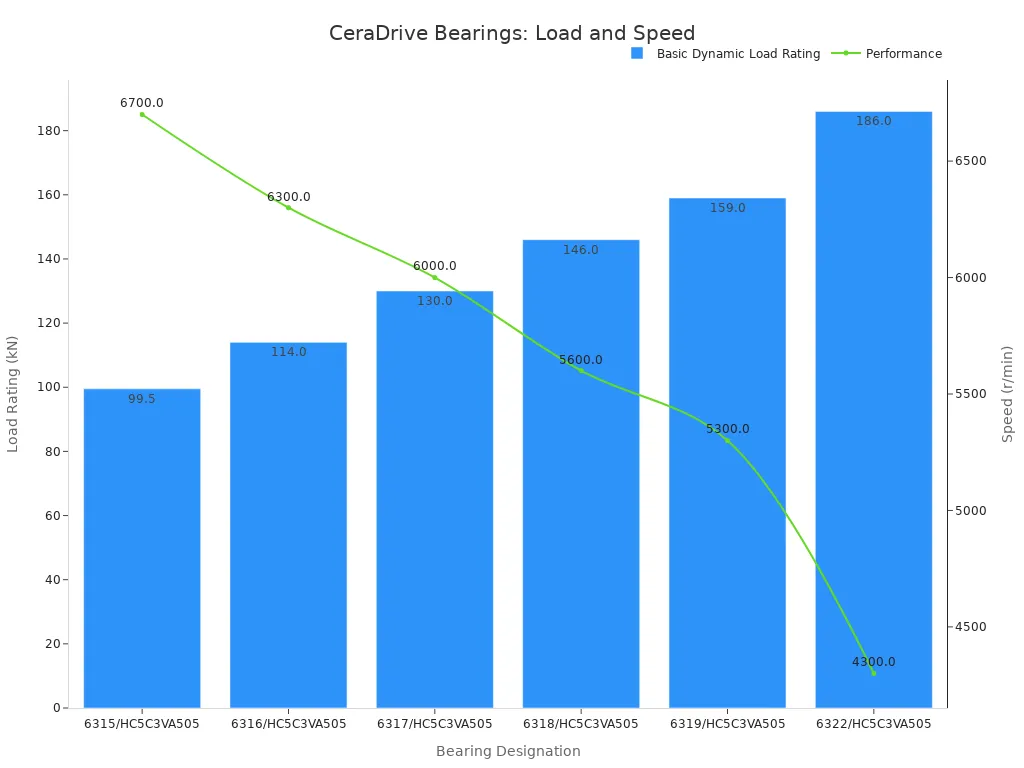
Electric motors show the load and speed envelope in practice. IBT Inc. lists its CeraDrive hybrid range as follows:
Designation | Bore × OD × Width | Dynamic Load Rating | Speed |
|---|---|---|---|
6315/HC5C3VA505 | 75 × 160 × 37 mm | 99.5 kN | 6,700 r/min |
6316/HC5C3VA505 | 80 × 170 × 39 mm | 114 kN | 6,300 r/min |
6317/HC5C3VA505 | 85 × 180 × 41 mm | 130 kN | 6,000 r/min |
6318/HC5C3VA505 | 90 × 190 × 43 mm | 146 kN | 5,600 r/min |
6319/HC5C3VA505 | 95 × 200 × 45 mm | 159 kN | 5,300 r/min |
6322/HC5C3VA505 | 110 × 240 × 50 mm | 186 kN | 4,300 r/min |
IBT Inc. also charts these ratings against speed, and the pattern is clear: larger bearings carry more load at lower speed.
Zirconia fits a different profile. JN Bearings lists its fracture toughness at 8–10 MPa·m½, the highest among bearing-grade ceramics, with density of 5.9–6.1 g/cm³. That density still runs 20–25% below steel. Zirconia absorbs higher impact loads without catastrophic failure, which makes it the preferred choice for full ceramic bearings in harsh chemical and submerged service.
Pumps, Seals, and Ball Valves
Fluid-handling equipment exposes every component to moisture, chemicals, and abrasive slurries. Ceramic balls resist corrosion from acids, bases, and salts, HAXB Bearings notes, so they suit chemical and marine conditions. Full ceramic bearings also run with little or no lubrication, according to PIB Sales, and they serve pumps, valves, and chemical processing equipment. Zirconia balls appear in control valves, corrosive-service pumps, flowmeters, and safety valves, SD Balls reports. Silicon nitride and zirconia balls are non-magnetic and electrically insulating, which helps in aggressive media, high-performance valves, and instrument components. Designers should still review impact loads and seat geometry before specifying a ceramic grade.
Other Industrial Uses
Tower Packing and Filtration
Ceramic balls also serve as tower packing and filtration media. In fixed-bed reactors across petrochemical, fertilizer, and fine chemical plants, they form upper and lower support layers for catalysts. They distribute gas flow evenly, buffer material impact, and filter out impurities. This protection keeps the catalyst from being washed away or crushed, and it prevents bed blockage. Innovacera notes that ceramic packing balls suit catalyst support beds best, where they resist wear and keep gas flow uniform.
Water Treatment and Specialty Uses
Water treatment gives ceramic balls another role. In treatment facilities, they remove impurities without adding secondary pollutants, according to a LinkedIn industry report. Their durability and chemical stability support long-term operation, which lowers operating costs and environmental impact. Inert ceramic balls are replacing sand and activated carbon in this segment because of their longer life and better contaminant removal.
Household users also turn to these spheres for alkaline water. The balls release minerals such as calcium, magnesium, and potassium into the water. ZTAI Packing reports that this process can raise pH by up to 1.5. Users rinse the balls, place them in a glass or ceramic container of filtered water, and let them sit for at least 12 hours. Ideally, the water is consumed within 3 days. Compared with activated carbon filters or reverse osmosis systems, ceramic balls cost less and need less maintenance. They require no electricity and last longer.
High-efficiency dechlorination grades react with free chlorine and chloramine, converting them into harmless chloride ions without secondary pollutants, the Sweetwater Reporter notes. These balls contain no heavy metal ions or harmful additives, and a specialized sintering process supports a service life of 6–12 months under normal conditions.
Huari supplies ceramic balls in four materials: alumina, silicon carbide, silicon nitride, and zirconia. Each grade fits a different duty, from general packing to harsh chemical service.
Ceramic balls cover five main duties: catalyst bed support, grinding media, thermal storage, bearings and valves, and tower packing or water treatment. Each duty rewards a different property. Bed support demands inertness, grinding demands hardness and wear resistance, heat storage demands thermal stability, and bearings demand toughness. ISK Bearing sums up the matching logic well:
Full ceramic bearings (ZrO2 / Si3N4) are suitable for corrosive or high-temperature extreme environments. Hybrid ceramic bearings (with GCr15 or SS rings) retain higher impact toughness while pursuing efficiency.
That same logic applies beyond bearings. These spheres work in chemical and thermal process roles and in mechanical roles, which makes them a versatile component across many industries.
FAQ
Which ceramic ball material suits catalyst bed support?
Alumina and other inert ceramic grades fit this duty best. They stay chemically silent, carry the catalyst load, and resist process temperatures near 1000°C. High-purity alumina protects precious metal catalysts from silica and iron contamination.
Do ceramic grinding balls contaminate the product?
They release minimal debris and no metallic ions. Steel media shed iron and chromium with every impact. Ceramic media keep iron and chromium content low, which matters for pharmaceuticals, food, white pigments, and battery materials.
Why do thermal storage beds use ceramic balls instead of honeycomb blocks?
Loose ball packing handles dust-laden flue gas and high-strength duty. Balls are easy to replace and reuse. Honeycomb blocks offer lower pressure drop, but they suit clean gas and need complex cleaning.
When should a designer choose silicon nitride over zirconia?
Silicon nitride fits high-speed, low-friction duty such as machine tool spindles and hybrid bearings. Zirconia brings the highest toughness and density, so it handles impact loads and harsh chemical or submerged service.
Can ceramic balls raise drinking water pH?
Yes. Alkaline water balls release calcium, magnesium, and potassium into filtered water. Users rinse the balls, soak them for at least 12 hours, and consume the water within 3 days.
Please Contact Us!


Recent News
1.Why Are Ceramic Balls and Tungsten Carbide Balls Favored in the Aerospace Industry?
2025-07-102.Can Ceramic Balls Conduct Electricity? Unveiling Their Electrical Properties
2025-07-073.Performance and Solutions of Ceramic Balls in High-Temperature Environments
2024-09-034.Wear resistance analysis of high performance ceramic balls
2024-09-025.Comparing Hardness: Ceramic Balls vs. Steel Balls
2024-06-066.Exploring the Versatility: What Are Ceramic Balls Used For?
2024-03-07